
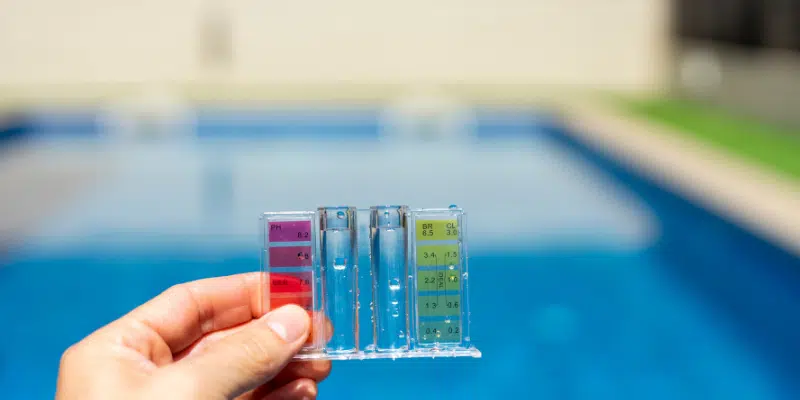
Here is the short answer: clear pool water is not always safe pool water. Water can look crystal clear and still have chemistry that is out of balance, which means testing pool water regularly is the only way to know for certain that your pool is safe to swim in. Clarity tells you the water looks nice. It does not tell you whether your pH is in range or whether your equipment is quietly being damaged.
Let’s look at why clear water can be deceiving, what your water might be hiding, and how simple testing keeps your pool safe all season long.
Can Clear Pool Water Be Unsafe?
Yes. Clarity and safety are two different things. Water becomes cloudy or green when there is enough of a problem to see with the naked eye, usually a significant algae bloom or a heavy load of particles. Long before water reaches that visible stage, its chemistry can drift out of the safe range while still looking perfectly inviting.
A pool with low chlorine can look completely clear for a day or two before bacteria and algae begin to establish themselves. A pool with high pH can look pristine while the chlorine in it is barely doing its job. Clear water is a snapshot of how things look right now, not a report on whether the water is actually sanitary.
Create Your Perfect Backyard Escape
From pools to hot tubs, we help homeowners across Oakville, Burlington, Toronto, and the GTA choose the right solution for their space, budget, and lifestyle.
Get In TouchWhat Clear Water Might Be Hiding
Ineffective Sanitizer
Chlorine is only fully effective within a specific pH range. When your pH climbs to 8 or higher, the chlorine in your pool loses a significant amount of its sanitizing power, even if the chlorine reading itself looks fine. Your test strip might show chlorine present, but if the pH is too high, that chlorine is not protecting swimmers the way it should. Clear water with weak sanitizer is one of the most common hidden problems in home pools.
Bacteria and Early Algae
Harmful bacteria are invisible. So is algae in its earliest stage, before it clouds the water or coats the walls. A pool that has not been tested in a week or two can be developing a problem that has not yet become visible. By the time you can see it, you are dealing with a much bigger and more expensive correction than a simple chemical adjustment would have been.
Water That Is Quietly Damaging Your Pool
Water chemistry that is out of balance does not just affect swimmers. Water that is too acidic corrodes metal fittings, etches plaster, and wrinkles vinyl liners. Water that is too alkaline causes scaling and cloudy buildup on surfaces and equipment. Water sitting at a pH of 7 or below can wrinkle liners and cause heaters to fail in as little as 6 weeks. None of that damage announces itself in the clarity of the water.
What Should You Test For?
A complete water test looks at more than just chlorine. The core measurements every pool owner should be checking are:
- pH: The measure of how acidic or basic your water is. Aim for 7.4 to 7.6. This is the single most important reading because it affects everything else, including how well your chlorine works.
- Chlorine (or sanitizer): Keep free chlorine between 1 and 3 parts per million to properly kill bacteria and algae.
- Total alkalinity: This acts as a buffer that keeps your pH stable. When alkalinity drifts, your pH becomes difficult to control.
- Calcium hardness: Too little and the water pulls calcium from your surfaces and equipment. Too much and you get scaling.
- Cyanuric acid (stabilizer): This protects chlorine from being burned off by the sun. Too little and your chlorine disappears fast. Too much and it becomes less effective.
How Often Should You Test Pool Water?
As a general rule, test your water at home at least once a week during swim season and have it professionally tested once a month. You should also test more frequently in a few specific situations, because these are the moments when water chemistry shifts fastest:
- After heavy rain, which dilutes chemicals and changes pH
- During a heat wave, when higher temperatures accelerate chlorine loss
- After a party or heavy bather load, when sweat, sunscreen, and oils overwhelm your sanitizer
- For an accurate reading, take your sample from about elbow depth, away from the return jets, and test or deliver it promptly.
At-Home Testing vs. Professional Testing
Both have a place in a good pool care routine. At-home test strips and kits are quick, convenient, and perfect for the regular weekly checks that keep you on top of your water. They give you an immediate read on the essentials so you can make small adjustments before anything drifts too far.
A professional test goes deeper. At Leisure Industries, you can bring a water sample into our showroom for a professional computer water test that measures your full chemistry with a precision that home strips cannot match. It is a good idea to get a professional test once a month. If you are ever unsure what your results mean or what to add, our team is happy to walk you through it. Stop by with a sample and we will help you figure out exactly what your pool needs. Explore our full range of pool chemicals and water balancers to see what we keep in stock.
What Happens When You Skip Testing
Skipping regular testing is one of the more common pool maintenance mistakes we see, and it tends to snowball. Unbalanced water can lead to itchy skin and irritated eyes, algae blooms that take over quickly, and long-term damage to liners, heaters, and other equipment. According to Health Canada, maintaining proper sanitizer and pH levels is essential to preventing the growth of harmful bacteria in recreational water. Testing is the small, simple habit that prevents every one of those bigger problems.
Keep Your Water Safe, Not Just Clear
Clear water is a good sign, but it is not proof that your pool is safe. Regular testing is what turns good-looking water into genuinely healthy water, and it is one of the easiest habits a pool owner can build.
At Leisure Industries, we have spent over 50 years helping families across Oakville, Burlington, and the GTA keep their pools safe and swim-ready. Bring us a water sample for a professional test, pick up the chemicals you need, or ask us anything about your water chemistry. Contact us today or stop by the showroom, and we will help you keep your water safe as well as clear.